Covered Call Strategy: 5 Tips to Maximize Investment Returns
Five tips for building a systematic covered call program: defining objectives, standardizing strikes, pricing volatility, and controlling execution friction.
Covered Call Strategy: How to Maximize Investment Returns
Listed options activity increased materially throughout recent trading sessions. Execution quality matters significantly when client trading frequency rises. Multiple US regulatory changes recently altered standard operational expectations for advisory firms.
These shifts include tighter settlement cycles and enhanced privacy safeguards. Wealth managers might need to adapt their processes to keep pace with these market infrastructure updates. Improved vendor oversight remains a critical focus area.
-
Market pace: Cboe reported Q2 2026 average daily listed options volume of 72.8 million contracts.
-
Broker-dealer margin framework: FINRA adopted intraday margin standards effective June 4, 2026.
Learn how advisors scale option overlays
What Is A Covered Call Strategy?
A covered call strategy involves holding underlying shares. You then sell a call option against those exact shares in the same account.
The payoff outcome provides an upfront premium. This setup might cap your upside above the selected strike price. The downside risk remains tied to your owned shares.
-
Inputs: Underlying ticker, shares in 100-share blocks, strike, expiration, and implied volatility.
-
Outputs: Option premium, assignment risk, realized option P/L, and potentially realized stock sale.
-
Common use cases: Income overlay on large-cap equity sleeves.
-
Risk mitigation: Reducing portfolio volatility in sideways markets.
| At Expiration | Stock Vs Strike | Call Outcome | Stock Outcome | Net Effect |
|---|---|---|---|---|
| Stock < strike | Below | Expires | Keep shares | Keep premium; shares down |
| Stock ≈ strike | Near | May expire | Keep shares | Premium retained |
| Stock > strike | Above | Assigned | Shares sold at strike | Premium kept; upside capped |
Tip #1: Define The Covered Call Program Objective
A covered call program is never a uniform approach for every client. You must define the primary objective first. Strike selection and assignment tolerance depend on this baseline goal.
These parameters might dictate your entire operational workflow. The underlying portfolio mandate guides the overlay design.
-
Account type: Tax rules differ depending on taxable, qualified, or trust registrations.
-
Assignment tolerance: Policies might allow, minimize, or strictly prohibit assignment.
-
Concentration: Managers might apply this to a single stock or a diversified sleeve.
-
Constraints: Cash needs, target volatility, and restricted lists influence trading limits.
| Program Design | Primary Goal | Assignment Posture | Typical Account Fit | Primary Risk |
|---|---|---|---|---|
| Premium-first | Maximize option premium | Assignment accepted | Retirement or tax-exempt | Opportunity cost in rallies |
| Assignment-avoid | Reduce call-away risk | Rolls to reduce assignment | Taxable concentrated holders | Roll costs and P/L churn |
Tip #2: Standardize Your Covered Call Strategy Strike Selection
Strike selection directly influences premium size and assignment probability. Advisors might use a repeatable method to control risk drift. This framework helps maintain discipline during shifting market conditions.
Picking the highest premium often introduces inconsistent portfolio behavior. A systematic covered call strategy demands measured, rule-driven strike targets.
Explore rules-based options software for advisors
-
Delta target approach: Choose strikes by target delta band to standardize risk.
-
Percent-out-of-the-money approach: Choose strikes a set percentage above spot price.
-
Minimum premium threshold: Require a minimum premium value per unit of time.
-
Consistency check: Apply the selected method evenly across similar client accounts.
| Method | What It Controls | Strength | Weakness |
|---|---|---|---|
| Delta-based strike | Probability and sensitivity | Consistent across volatility regimes | Needs reliable option data |
| % OTM strike | Distance to strike | Simple client explanation | Inconsistent risk across names |
| Premium floor | Trade frequency | Avoids low-value trades | May reduce consistency of overlay |
Tip #3: Treat Covered Call Pricing As Volatility And Time
Effective covered call pricing requires evaluating extrinsic value. The premium heavily relies on implied volatility and time to expiration. It is rarely a simple yield quote.
Market events drastically alter the final option value. Time decay profiles change continuously as expiration nears.
-
Implied volatility: Put and call skew might change relative pricing dynamically.
-
Days to expiration: Time decay alters the option value as the deadline approaches.
-
Event calendar: Earnings dates and ex-dividend dates require strict monitoring.
-
Bid-ask spread: Avoid strikes with poor fill quality unless policy permits.
Tip #4: Write Down Covered Call Management Rules Before Trading
Proper covered call management relies on defined action triggers. You should write down these specific rules before initiating any trades. Clear guidelines help govern when to roll or close a position.
This discipline might reduce emotional decision-making during volatile sessions. Governance logs prove execution intent during regulatory reviews.
-
Time-based triggers: Roll positions when days to expiration drop below a specific target.
-
Moneyness triggers: Roll when the underlying stock breaches the strike price.
-
Profit triggers: Close when the option reaches a defined percentage of maximum profit.
-
Dividend triggers: Manage early assignment risk prior to ex-dividend dates.
Tip #5: Control Friction For Your Covered Call Program
Net investment returns depend heavily on friction controls during execution. Tax treatments, commissions, and operational error rates impact the final outcome. Firms should evaluate how their infrastructure handles these inevitable costs.
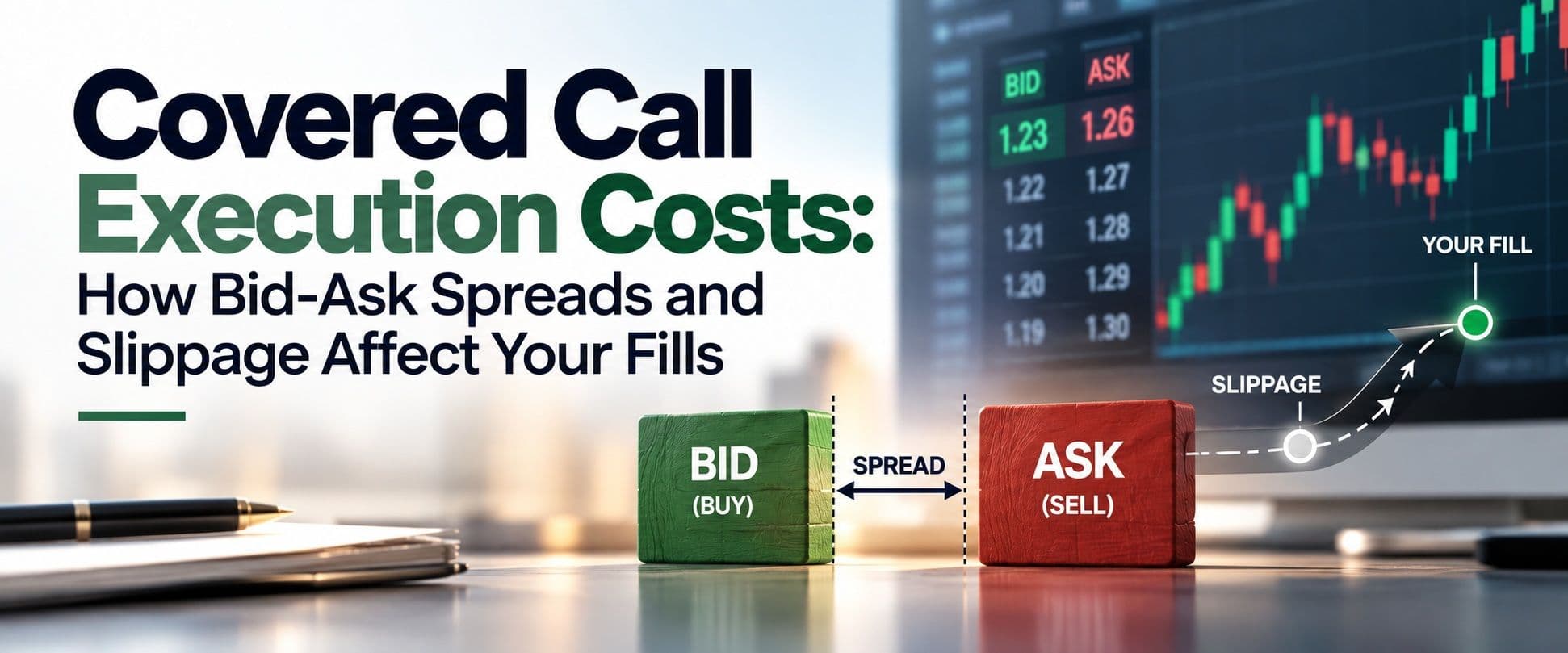
Slippage and wide bid-ask spreads drag down net premiums. A scaled covered call program requires institutional-grade execution pathways.
-
Taxes: Document how you handle option premium and rolling P/L outcomes.
-
Trading costs: Set maximum spread thresholds and monitor execution quality.
-
Operational controls: Enforce minimum share logic and implement auto-exit safety measures.
-
Compliance: Maintain a best execution process alongside proper vendor oversight.
AcuBooth: A Dedicated Covered Call Platform For Financial Advisors
AcuBooth functions as a systematic covered call platform for financial advisors and institutional wealth managers. The system runs an execution-only overlay on designated client sleeves. It operates entirely within the client's existing custodian account.
Schedule a platform demo with AcuBooth
The platform does not take asset custody at any point.
-
Session monitoring: Continuous monitoring and execution occur throughout the trading session.
-
Rule sets: Deterministic rules drive explainable and auditable trade triggers.
-
Asset location: Client assets stay securely at their current custodian.
-
Portfolio authority: The advisor retains full control of the core portfolio allocations.
-
Minimums: Enforces strict 100-share minimum contract parameters.
-
Caps: Applies specific share caps per symbol.
-
Pauses: Allows a pause symbol option to halt new orders.
-
Auto-exit: Closes calls automatically if underlying shares are sold.
| Feature | Manual Management | AcuBooth Continuous Overlay |
|---|---|---|
| Monitoring frequency | Weekly or monthly | Continuous during market session |
| Execution consistency | Advisor-dependent | Deterministic rules |
| Audit trail | Manual notes | Rule-linked execution logs |
| Scalability | Limited by staff time | Designed for scale across accounts |
| Custody | At custodian | At custodian |
Conclusion
For firms seeking a systematic infrastructure, AcuBooth serves as a dedicated covered call platform for financial advisors that executes a deterministic overlay directly within existing custodian accounts. The system monitors market sessions continuously and logs auditable trade triggers without taking asset custody, supporting an advisory firm's operational consistency and governance requirements.
Stay ahead on covered call strategy
Insights, market commentary, and updates from the AcuBooth team — delivered to your inbox.